

In an era of heightened focus on the environment and health, efficient and reliable water and wastewater treatment technologies play a pivotal role, whether it is the municipal water supply that ensures the safety of our daily drinking water or in precision manufacturing industries such as pharmaceuticals and food & beverage. Among the numerous filtration and separation technologies, the ceramic membrane filtration system, with its unique and powerful performance, is gradually emerging as a highly regarded and effective solution. This article will provide you with a comprehensive yet accessible understanding of this technology, revealing its working principles, advantages, applications, and future development trends.
► Delving into the Ceramic Membrane Filtration System: What Exactly Is It?
In simple terms, the ceramic membrane filtration system is a precision filtration device made from inorganic ceramic materials (primarily alumina, zirconia, or titania). Imagine it as a "sieve" with billions of microscopic pores, the size of which is precisely controlled. When liquid flows through this "sieve," small molecules like water can pass through smoothly, while impurities such as suspended particles, microorganisms, and macromolecules are blocked, thus achieving liquid separation and purification.
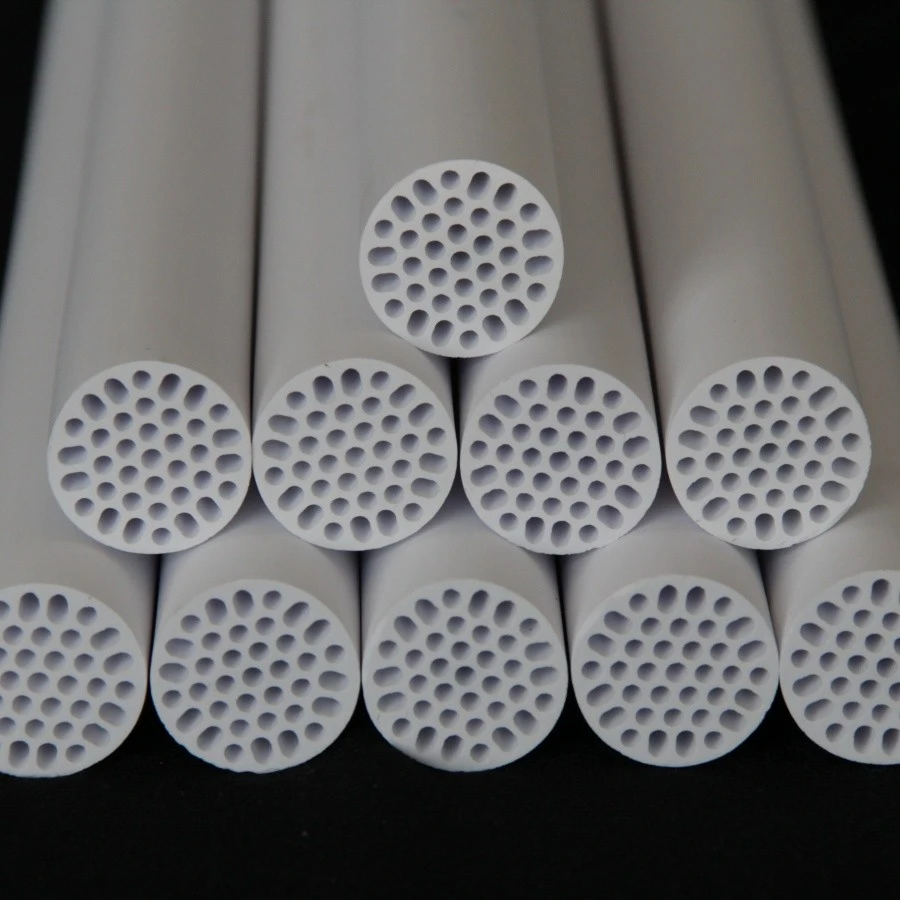


This technology is highly flexible. By adjusting the pore size of the ceramic membrane, it can achieve different levels of filtration precision, from microfiltration (MF) and ultrafiltration (UF) to nanofiltration (NF), meeting a wide variety of complex separation needs.
► Working Principle: Precision Separation Driven by Pressure
The core principle of ceramic membrane filtration can be summarized as "pressure-driven separation." Let's break down its workflow step by step:
► Step 1: Incoming materials
The liquid to be treated (referred to as the "feed liquid") is pumped into the membrane module under a certain pressure.
► Step 2: Permeation and Rejection
Under pressure, the feed liquid flows across the ceramic membrane surface. Substances smaller than the membrane pores (such as water molecules and some inorganic salts) pass through the membrane wall to form the "permeate," while substances larger than the membrane pores (such as suspended solids, bacteria, viruses, and large protein molecules) are rejected and become concentrated on the other side of the membrane. To enhance filtration efficiency and extend the membrane's service life, two different filtration modes are commonly employed:
Cross-flow Filtration: This is the most common mode. The feed liquid flows at high velocity parallel to the membrane surface, while the permeate passes perpendicularly through the membrane. This flow pattern effectively "scours" the membrane surface, slowing the accumulation of contaminants (the "filter cake layer") and maintaining stable filtration performance.
Dead-end Filtration: The feed liquid flows perpendicularly to the membrane surface, and all substances larger than the membrane pores are trapped on the membrane surface. This mode is relatively simple but is prone to clogging and is typically used for liquids with low impurity content.
► Step 3: Collection and Cleaning
The filtered, clean liquid (permeate) is collected on the other side of the membrane. As operation time increases, contaminants accumulate on the membrane surface, affecting filtration efficiency. At this point, the system will strip away the contaminants through backwashing (flushing the membrane in reverse with permeate) or chemical cleaning, restoring the membrane's performance to like-new condition.
► Types of Ceramic Membranes: Categorized by 'Pore'
The key distinction between ceramic membranes lies in their pore size, which directly determines their separation precision and application scenarios.
► Microfiltration (MF) Membranes
With a pore size range roughly at the micron level, they are ideal for removing particulate matter, silt, bacteria, and most suspended solids from water.
► Ultrafiltration (UF) Membranes
The pore size is smaller than that of microfiltration membranes, falling between the micron and nanometer scales. Ultrafiltration (UF) is a common technology in water treatment, especially in ultrafiltration systems water treatment, capable of effectively removing finer impurities like viruses and large organic molecules (such as proteins and colloids).
► Nanofiltration (NF) Membranes
With pore sizes reaching the nanometer level, they can remove some divalent or multivalent ions (like calcium and magnesium ions, useful for water softening) as well as smaller molecular weight organic compounds.
► Core Materials: The Foundation of Powerful Performance
The reason ceramic membranes are so "robust and durable" is due to their unique inorganic material properties. These materials endow the membranes with excellent mechanical strength, chemical stability, and thermal stability. Common core materials include:
Alumina (Al₂O₃): Known for its high mechanical strength and good chemical resistance, it is one of the most widely used ceramic membrane materials.
Zirconia (ZrO₂): Offers better thermal and chemical stability than alumina, especially in its resistance to strong alkaline environments.
Titania (TiO₂): Renowned for its outstanding filtration efficiency and chemical resistance, it is widely used in specific fields.
► Advantages and Challenges: A Double-Edged Sword
Like any technology, the ceramic membrane filtration system has its pros and cons.
► Significant Advantages:
Robust and Long Service Life: The mechanical strength of ceramic membranes far exceeds that of traditional organic membranes, making them less susceptible to damage. With proper maintenance, their service life can reach several years or even longer, far surpassing that of polymer membranes.
Exceptional Chemical Stability: It can handle harsh chemical environments, including strong acids, strong alkalis, and organic solvents, making it suitable for a very wide range of applications.
Excellent Thermal Stability: It can withstand high-temperature operations and steam sterilization, a feat many polymer membranes cannot achieve.
High Filtration Precision and Stable Flux: Its rigid structure prevents deformation under pressure fluctuations, ensuring consistent separation effects and processing capacity.
Easy to Clean and Regenerate: It can be thoroughly regenerated using various methods like backwashing and chemical cleaning, reducing fouling issues. This makes ceramic membranes perform exceptionally well in harsh industrial environments, particularly in Industrial ultrafiltration systems.
► Challenges:
Initial Investment Cost: Compared to polymer membranes, the manufacturing and initial procurement costs of ceramic membranes are relatively high.
Brittleness: Ceramic materials are inherently brittle and require careful handling during installation and operation to avoid strong mechanical shocks and vibrations.
Weight and Installation: Ceramic membrane modules are typically heavier, requiring more robust support structures and infrastructure.
► Application Fields: A Broad Stage for Excellent Performance
Thanks to its powerful performance, the ceramic membrane filtration system has a vast range of applications, covering nearly all industries that require high-standard liquid separation.
► Water Treatment & Wastewater Reuse
Municipal Water Supply: Used for the advanced treatment of tap water, effectively removing bacteria, viruses, and turbidity to ensure drinking water safety.
Industrial Wastewater Treatment: Treating difficult, highly polluted wastewater from industries like textiles, chemicals, and electroplating to achieve resource recovery and discharge compliance.
► Food & Beverage
Dairy Processing: Used for milk sterilization, whey protein concentration, and more.
Clarification of Fruit Juice and Wine: Effectively removes pectin, yeast, and suspended solids from juices and alcoholic beverages, improving product clarity and stability.
► Biotechnology & Pharmaceuticals
In the biotechnology and pharmaceutical industries, an efficient ultrafiltration membrane system is crucial for cell harvesting and product purification. Ceramic membranes can be used for the clarification of fermentation broth, purification of antibiotics, and removal of impurities from traditional Chinese medicine extracts.
► Chemical & Petrochemical
Catalyst Recovery: Efficiently recovering expensive nanocatalysts from reaction liquids.
Produced Water Treatment: Removing oil, suspended solids, and other pollutants from produced water in oilfields, enabling water reuse.
● Taihe Environmental Case Study: A Pioneer in the Practice of Ceramic Membrane Technology
As a company that has been deeply engaged in the environmental water treatment field for many years, Taihe Environmental has long applied the cutting-edge technology of the ceramic membrane filtration system to solve practical problems for our clients. Our successful collaborations with well-known domestic chemical enterprises like Minxiang Chemical and pharmaceutical industry leaders such as Qilu Pharmaceutical are the best testament to this.
In these partnerships, we fully leveraged the advantages of ceramic ultrafiltration membranes, such as their resistance to high temperatures and corrosion, and their high separation precision. We tailored ceramic membrane-based water ultrafiltration solutions for them, effectively solving their difficult wastewater treatment and material separation challenges during production. This not only helped our clients achieve environmental compliance but also created significant economic benefits through material recovery. These successful collaborations not only highlight the immense value of the ceramic membrane filtration system in practical industrial applications but also affirm Taihe Environmental Protection's profound technical expertise and extensive practical experience in this field.
► Frontier Trends and Innovative Directions
To pursue higher efficiency and lower energy consumption, technological innovation in the field of ceramic membranes has never ceased:
Hybrid Membrane Technology: Combining ceramics with other materials (such as polymers, graphene, and other nanomaterials) to develop hybrid membranes with superior performance and stronger anti-fouling capabilities.
Intelligent Operation and Maintenance: Integrating Internet of Things (IoT) and Artificial Intelligence (AI) technologies to achieve real-time monitoring of the membrane system's operational status, fault prediction, and automated cleaning, thereby significantly enhancing operational efficiency.
Green Manufacturing: Researching more environmentally friendly and energy-efficient production processes for ceramic membranes to reduce the environmental footprint from their manufacturing source.
Low-Energy Consumption Systems: Developing membrane systems that can operate under lower pressures to reduce operational costs, making them more economically competitive.
► Challenges and Future Outlook
Although the ceramic membrane filtration system holds great promise, its widespread adoption still requires overcoming certain challenges, such as further reducing manufacturing costs and developing more effective anti-biofouling strategies.
It is foreseeable that as the technology continues to mature and costs are progressively optimized, ceramic membranes will play an increasingly vital role in the global fields of water treatment and industrial separation.
► Conclusion
In summary, the ceramic membrane filtration system offers a highly efficient, durable, and powerful solution for the liquid separation and purification needs across various industries. While its initial investment is relatively high, its outstanding chemical and thermal stability, long service life, and efficient operational performance make its long-term, comprehensive benefits highly attractive. For industries and municipal units seeking stable, reliable, and high-efficiency filtration solutions, ceramic membrane technology is undoubtedly an option worthy of serious consideration. As emerging technologies continue to appear, it is bound to play an indispensable role in safeguarding water resource security and promoting sustainable industrial development.