

This article covers "how to select it and how to make it last"-which is where buyers most often stumble. Ceramic membranes for seawater filtration are not worry-free once purchased; choose the wrong boundaries or operate them the wrong way, and even the best membrane will die young.
1. Classify the Feed Water First: Neither Over-Design Nor Under-Design
The first step in selection is always "know your water," not "pick a membrane model."
1.1 Give the Feed a Check-Up
Before installing a ceramic membrane, first map the seawater's turbidity fluctuation range, algae and bacteria levels, organic content, oil risk, and pH and temperature ranges. This is not a box-ticking exercise; it is the basis for deciding the pore grade, pretreatment (whether coagulation is needed), and cleaning formulation. The more solid the water-quality data, the less likely the design will drift.
1.2 How to Choose the Grade: Microfiltration or Ultrafiltration
The separation precision of ceramic membranes generally lies in the microfiltration (MF) to ultrafiltration (UF) range. Roughly speaking: to intercept suspended solids, algae, and large particles and mainly protect RO's SDI, MF is often sufficient and has higher flux; if organics, colloids, and bacteria are a heavier load and finer rejection is required, use UF. The core logic of grade selection is to "just hold back what downstream RO requires," not "finer and more expensive is better"-over-fine wastes flux and increases fouling pressure.
1.3 Jar Tests and Pilots: Ground the Classification in Reality
However elegant the water-quality classification on paper, it must be validated by a jar test or pilot. A jar test typically uses on-site seawater to try different pore grades and coagulation conditions, observing flux decay rate, cleaning recovery, and whether product water meets downstream demand; a pilot scales up to near-real modules and operating rhythm, validating backwash cycles, CIP effectiveness, and system stability. The value of this step is to turn the selection decision from "inference from experience" into "evidence-based." Seawater is changeable, so ideally sample across seasons and water-quality states rather than deciding on one "fair-weather water."
2. The Hard Dimensions of Selection
Breaking selection into decidable dimensions is far more useful than staring at a single parameter.
|
Selection dimension |
Question to answer |
Why it matters |
|
Water-quality fluctuation range |
How much does quality swing during blooms/storms? |
Determines transient-resilience design and redundancy |
|
Pore grade (MF/UF) |
To what level must it reject to protect RO? |
Avoids over- or under-design |
|
Chemical-resistance need |
How strong must the cleaning acid/base/oxidant be? |
Determines material (alumina/zirconia/SiC) |
|
Space constraint |
How much footprint, can it be modular? |
Determines containerized vs. civil form |
|
Degree of automation |
Can it run unmanned with automatic backwash? |
Determines O&M cost and stability |
|
Matching with RO |
Do product-water and RO-intake scales align? |
Determines whole-plant water balance |
3. The TCO View: Higher Upfront, But This Is How the Account Works
Ceramic membranes are most often dismissed because of their "high upfront cost." But the engineering ledger is total cost of ownership (TCO), not unit purchase price.
3.1 Upfront vs. Service Life
Ceramic membranes cost more upfront than polymeric ones, but their life is counted in decades, far longer than the replacement interval of polymeric membranes in seawater. Turning "replace every few years" into "replace rarely or not at all for a decade" dilutes the upfront gap across long operating years.
3.2 The Hidden Costs of Downtime and Replacement
The most expensive thing in a seawater project is not the membrane but downtime and its knock-on losses: RO dragged down, capacity lost, emergency replacement, labor on site. Ceramic membranes reduce these hidden costs through less downtime, fewer replacements, and a more stable RO. The larger the scale and the higher the continuity requirement, the better this account looks.
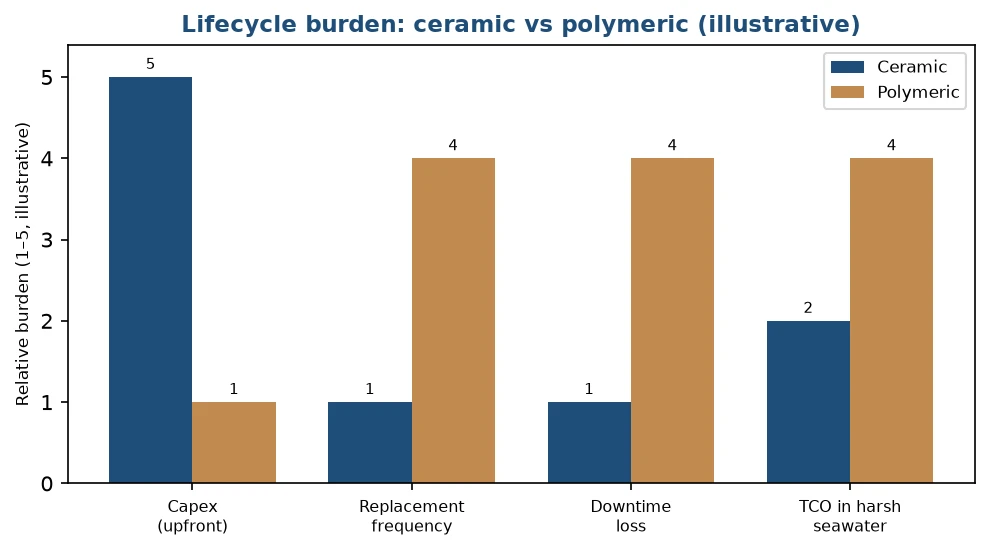
Picture:Qualitative life-cycle comparison of ceramic versus polymeric membranes: higher upfront but fewer replacements and less downtime,
giving a better TCO in harsh feed conditions (relative illustration, not specific measured values).
3.3 How to Build a TCO Model: Make Hidden Costs Explicit
Many projects "get TCO wrong" not by using the wrong formula but by omitting items. List these explicitly in the model:
Upfront (CAPEX): membrane elements + rack + pumps + controls + installation.
Replacement cost: annualized membrane replacement by life cycle-this is where ceramic and polymeric membranes differ most.
Energy: long-term power draw of the cross-flow loop, backwash, and cleaning pumps.
Chemicals: cleaning and pretreatment chemical consumption.
Downtime loss: converted from "what one downtime event is worth" by scenario-often the largest item in island and continuous-industrial projects.
Labor and maintenance: on-site O&M, remote monitoring, spares.
Only by spreading these across the full life cycle can you compare fairly. Concluding from the first line (CAPEX) alone almost guarantees a misjudgment.
4. Common Failure Modes and How to Avoid Them
However good the technology, misuse will defeat it. Listing common failure modes is a way of clearing risks in advance.
4.1 Operational Failures
Mismatch between cleaning formulation and material: assuming "a ceramic membrane can take anything" and using conditions beyond the material's tolerance, damaging the separation layer. Avoidance: set cleaning boundaries by material (alumina/zirconia/SiC).
Neglecting pretreatment: treating the ceramic membrane as a "universal front end"-letting it carry the entire load on its own-when coarse filtration and coagulation are inadequate. Avoidance: the pretreatment steps that should be done cannot be skipped.
Poor backwash/CIP rhythm: washing too little and flux collapses, or washing too hard and wasting chemicals and damaging the membrane. Avoidance: build cleaning triggers based on differential pressure and flux.
4.2 Design Failures
Over-design: blindly choosing the finest pore and maximum redundancy, yielding poor flux and high cost. Avoidance: select precisely by water-quality classification.
Under-design: cutting coagulation or security filtration to save money, torturing RO over the long run. Avoidance: hold the line on "protecting RO."
Module-field disconnection: containerized designs that ignore lifting, piping, and maintenance access, so they cannot be installed or operated smoothly on site. Avoidance: measure the space before defining the form.
Blind operation caused by missing instruments: no online differential pressure/flux/turbidity monitoring, so cleaning is all guesswork-trouble is only a matter of time. Avoidance: treat key instruments as standard, not optional.
Counting only upfront, not TCO: deciding on purchase price and ignoring the long-term costs of downtime, replacement, and cleaning. Avoidance: build a TCO model at the project stage.
|
Failure mode |
Typical cause |
Avoidance point |
|
Material/cleaning mismatch |
Cleaning beyond tolerance |
Set cleaning boundaries by material |
|
Excess front-end load |
Pretreatment omitted |
Coarse filtration + coagulation + ceramic membrane staged |
|
Poor cleaning rhythm |
Triggered by experience, not data |
Differential-pressure/flux triggers |
|
Over-/under-design |
No water-quality classification |
Precise, graded selection |
|
Module-field disconnection |
Site space not measured |
Define form before integration |
|
Blind operation |
Missing online instruments |
List key instruments as standard |
|
Upfront-only accounting |
TCO ignored |
Build a TCO model at project start |
4.3 A Framework for Reviewing a Failure
When something does go wrong, the effective approach is not to replace the membrane immediately, but to trace back through four layers-water quality, pretreatment, operation, cleaning: first check whether the feed changed (bloom, storm, oil slick), then whether pretreatment (coarse filtration, coagulation) failed, then whether operating parameters (flux, differential pressure, backwash) drifted, and finally whether the cleaning formulation and rhythm are on target. Most "membrane problems" are rooted outside the membrane. Making the review into a procedure is how you avoid stepping in the same pit twice.
5. O&M Rhythm: Make "Cleaning" Routine
Half of a ceramic membrane's advantage lies in its cleanability. Arrange cross-flow, backwash, air scouring, and CIP into a rhythmic O&M calendar, combined with online SDI/turbidity monitoring, and "fouling" turns from a sudden incident into a predictable, manageable routine. This is especially true for offshore, minimally staffed scenarios-automatic backwash plus remote monitoring makes "stable with few people" possible.
One point often overlooked: the O&M rhythm must adjust with seasonal water quality. During bloom season, the rainy season, and algal peaks, the fouling load differs from normal days, and backwash and cleaning trigger thresholds should tighten accordingly. Upgrading from a "fixed calendar" to "dynamic adjustment with water quality" is how you fully exploit the ceramic membrane's cleanability. This is also why online monitoring is not a luxury but a precondition for the system's long-term economics.
6. Acceptance and Handover: Don't Leave Problems to Operation
Installing the system is only the beginning. How solid the acceptance and handover are determines whether the coming years are "smooth operation" or "running while repairing." Before handover, confirm:
Performance acceptance: under agreed conditions, do product-water quality and flux meet targets, and does cleaning recovery work properly?
Document handover: are the operating manual, cleaning formulations, spare-parts list, drawings, and instrument calibration records complete?
Training handover: do on-site staff really know how to operate, judge, and perform basic cleaning?
Interface confirmation: are the flow, quality, and control interfaces with adjacent stages (intake, RO, discharge) aligned?
Closing these loops at the handover stage is how the "design intent" truly reaches the operators.
7. The Metrics O&M Should Watch
The key to making a ceramic membrane filtration system "last" is watching the right metrics and acting early. The daily essentials are:
Transmembrane pressure (TMP) trend: a slow rise is normal; a sharp jump usually signals fouling or upstream loss of control.
Flux recovery: how far it returns after each cleaning is the core measure of membrane "health."
Cleaning frequency and chemical consumption: a persistent rise means pretreatment or the cleaning strategy needs review.
Product-water quality (turbidity/SDI, etc.): holding RO's "comfort zone" is this system's fundamental job.
Metrics are not for reports but for triggering actions: when a trend turns abnormal, go back to the water quality, the pretreatment, and the cleaning rhythm. Turning "O&M" from reactive repair into proactive management is how the ceramic membrane's long-term economics are truly realized.
8. Methodological Summary
Selection and O&M ultimately return to the same three steps: first do a water balance, then classify water quality, and finally calculate the payback period.
Water balance: confirm intake capacity and product-water demand to set scale and redundancy.
Water-quality classification: map the fluctuation and pollutant composition to set pore grade, pretreatment, and cleaning formulation-this step directly determines over-design versus under-design.
Payback calculation: use TCO rather than upfront cost, factoring in downtime, replacement, and cleaning.
In delivering ceramic membranes for seawater filtration, Taihe Environmental Protection emphasizes a closed loop of "classify first, then select, then define TCO, then schedule O&M": fully understanding the feed water and scenario boundaries before letting the ceramic membrane enter the system in the appropriate form and cleaning logic-helping users get this seawater pretreatment account straight and make it last. Wherever a project has thought through water-quality classification, cleaning rhythm, and scenario constraints, the long-term performance of the ceramic membrane usually justifies its upfront cost.