

1. A Widespread Misconception
1.1 Where "single-pass RO + EDI is enough" Comes From
When many people draw an ultrapure water (UPW) process flow for the first time, they instinctively write "pretreatment → single-pass RO → EDI → polishing." The combination looks logical: RO has already blocked most of the salts and ions, so EDI just needs to finish the job. A Double Pass RO System For EDI Pretreatment often gets dismissed by beginners as "over-design" - after all, a second-pass RO means one more high-pressure pump, one more pressure-vessel rack, and one more energy pass. Why not just stay with a single pass?


The source of this misconception is simple: everyone has heard that "RO has a very high salt rejection," and naturally assumes "very high" means "high enough." But the most punishing part of desalination is precisely "the last fraction." A single-pass RO blocks over 99% of everything, yet what decides whether EDI lives long and runs stably is exactly the fraction that leaks through. Betting a system's reliability on that leak is the common opening of every EDI premature aging story.
1.2 The Real Cost Behind the Misconception
Feeding single-pass RO permeate straight to EDI may look acceptable on the resistivity meter for a while, but problems erupt after a few months: stack voltage drift, resin hardening, scaling on the concentrate side, and soaring cleaning frequency. By the time the EDI module ages prematurely and the outlet resistivity drops out of spec, tracing the cause is often impossible - was it RO failing to block, or EDI tiring on its own? We have seen too many projects where, to save one second-pass RO up front, they later paid with the entire EDI stack's lifespan and repeated shutdown maintenance. That bill is almost never calculated at the bidding stage.
2. Build the Intuition First: RO Rejects What Is "Charged"
2.1 How the Membrane Works
To understand what a single pass leaks, first understand what an RO membrane actually blocks. A reverse-osmosis membrane is essentially a "sieve that looks at charge and size": for charged ions (sodium, calcium, chloride), combined with high pressure and hydrated radius, it blocks them efficiently; for sized molecules it also catches most. But once a substance exists in a "neutral, uncharged, and membrane-permeable" form, rejection drops off a cliff. The problem is that natural water carries several key contaminants that are exactly uncharged at neutral pH.
2.2 Why "the Last Bit" Is the Hardest
There is also a counter-intuitive point: no matter how high RO rejection is, the residual concentration is proportional to the feed concentration. The higher the feed salinity, the larger the absolute amount that leaks through at the same rejection. So the "leak" is not only a proportion problem but an absolute-mass problem. For a device with an extremely narrow tolerance window like EDI, absolute mass matters far more than proportion - even a millionth of hardness leaking through accumulates enough over months to form a crust on the resin that ordinary cleaning cannot fully remove.
3. What Does a Single-Pass RO Actually Leak?
3.1 Carbon Dioxide: the Only Gas That Walks Through the Membrane
Carbon dioxide is a neutral gas molecule, barely rejected by the RO membrane, and passes straight through with the permeate. On the permeate side it recombines with water into carbonic acid, pulling pH down and conductivity up. In other words, the more diligently single-pass RO removes salts, the more prominent CO₂ becomes in relative terms - because everything else is gone, yet it took the back door. This "acid load" lands entirely on EDI, whose efficiency at handling free acid is far worse than handling ionized salts. More subtly, CO₂ also enriches on the EDI concentrate side, indirectly raising voltage and energy use.
3.2 Silica: a Rejection Rate That Is Overrated
Silica is common in natural and process water; single-pass RO's rejection of it looks decent, but once the downstream is a boiler or EDI, the requirement is an extremely low residual. There is a cruel arithmetic here: even with very high overall removal, the residual silica slowly deposits on the EDI ion-exchange resin surface and inside the stack concentrate side. It does not clog you at once; it spends months building a hard shell on critical components, and once formed, routine cleaning struggles to remove it completely.
3.3 Boron and Weakly Ionized Species: Almost Unrejected When Neutral
Boron exists as boric acid at neutral pH - an uncharged molecule the RO membrane rejects poorly. A long list of similar weakly ionized substances are "invisible" at neutral conditions: the membrane cannot see them, cannot catch them. Only by raising pH to ionize them into charged forms can the membrane grab them. Yet single-pass RO permeate is exactly neutral-to-acid - handing those substances a free passage window. Alone, their effect is limited, but in boron-sensitive irrigation or specific processes, the accumulation is not negligible.
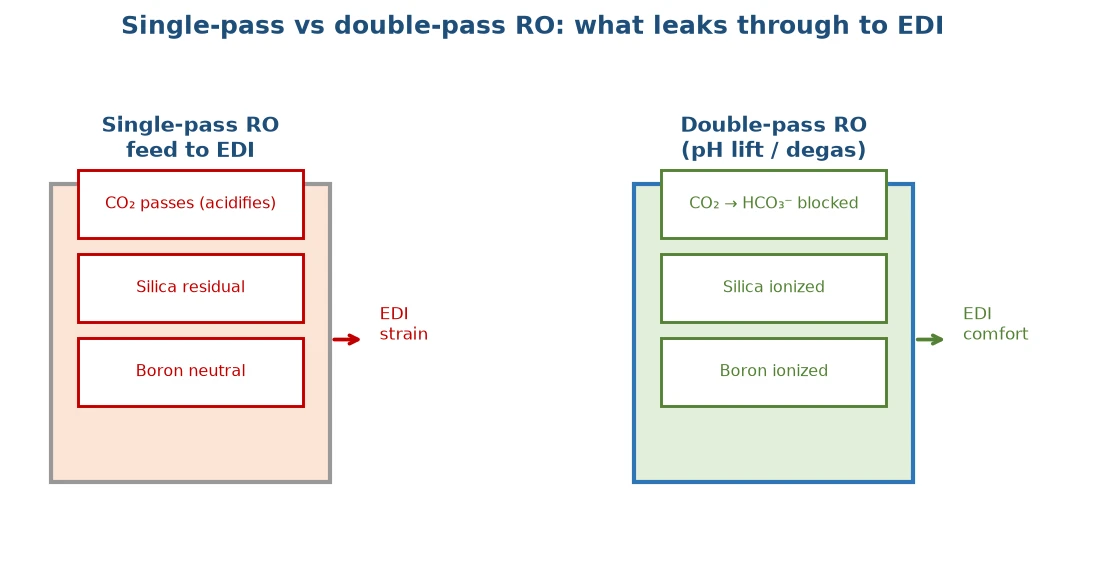
Picture:Single-pass vs double-pass RO: what leaks through to EDI (CO2 / silica / boron)
4. EDI Is Not a "Second Treatment" - It Is a Polisher
4.1 How It Works Makes It Delicate
Electrodeionization (EDI) is essentially "electrically regenerated mixed-bed ion exchange": water flows through resin-filled dilute chambers bounded by cation- and anion-selective membranes; a DC field pulls ions into concentrate chambers while water-split H⁺ and OH⁻ continuously regenerate the resin, so no acid or caustic is needed. The mechanism is elegant, but it presupposes very clean feed. EDI excels at "making already-pure water purer," not at "rescuing water that still carries impurities." Once hardness, silica, CO₂, chlorine, or organics exceed its tolerance, resin and stack suffer together.
4.2 The Chain Reaction of Exceeding Tolerance
Hardness ions form difficult-to-reverse scaling on the resin surface; silica enriches on the concentrate side and crusts the membrane and resin; free chlorine directly oxidizes membrane and resin; organics lay a biofilm on the resin bed. Each alone is not fatal, but together they retire the EDI module early. Worse, the EDI module is expensive, and once it fails the entire UPW line stops. So "protecting EDI's feed" was never a nice-to-have - it is the lifeline of the whole line. A often-overlooked fact: when an EDI module dies, it is rarely EDI's own fault; it is the RO in front failing to watch the gate.
5. Double Pass RO Is the Gatekeeper of EDI
5.1 The Second Pass Re-scoops the "Leakers"
The core idea of a Double Pass RO System For EDI Pretreatment is to send single-pass RO permeate through a second membrane array. Because the second-pass feed is already very clean (low salt, low SDI), it can run at high recovery, and its concentrate is clean enough to return to the first-pass feed - so overall water loss is small. More importantly, the second pass delivers a deep desalting polish on "already-clean water," pushing residual salt, silica, and boron down to a level EDI can accept stably. This second sweep is the safety margin a single pass can never give.
5.2 The Interstage pH Lift Is the Real Trick
What truly transforms the second-pass RO is the chemical step between the two stages. Before first-pass permeate enters the second pass, caustic can be dosed to lift pH into the weak-alkaline range: dissolved CO₂ converts to bicarbonate (charged, rejected by the membrane), and silica and boron shift from neutral molecules to charged ions (also rejected). This step is almost impossible on the first-pass RO - raw water hardness would scale the moment pH rises; but the second-pass feed is already clean, so lifting pH carries no scaling risk. So the value of a Double Pass RO System For EDI Pretreatment is 70% in the second pass and 30% in that pH step; neither works without the other.
5.3 Degasification as the Other Route
If a project dislikes dosing caustic, a membrane contactor or vacuum degasser between the passes can physically strip dissolved CO₂, likewise lowering the second-pass acid load. This route saves dosing but adds a unit and is more sensitive to operation. Either lifting pH or degassing solves the same problem - keep CO₂ out of EDI. Which to choose depends on your water quality, maintenance habit, and dosing-compliance needs, not on which sounds fancier.
6. When You Can Actually Skip the Double Pass
6.1 The Rare Cases Where Feed Is Already Very Clean
If the raw water is already high-quality softened water, or after rigorous pretreatment CO₂ and hardness are both extremely low, single-pass RO permeate may already sit inside EDI's tolerance window. In that case forcing a double pass is indeed over-design. But "very clean" is a hypothesis that must be falsified by a water-analysis report, not a default assumption - most field water is not that ideal. Our recommended order: get the report first, then discuss configuration, not the reverse.
6.2 The Compromise of Degas + Softening Instead
Some projects use upstream softening to remove hardness first, then degassing to strip CO₂, pulling single-pass RO permeate into EDI's window. Such compromises work for specific waters but make the system more complex and maintenance more demanding. In other words, skipping the double pass is fine, but you must use other means to recover those "leaked indicators," or the bill will eventually land on EDI. A compromise is not subtraction; it is replacing one set of measures with another, and total complexity is not necessarily lower.
7. An Operational Judgment Framework
Distill all the above into one executable line of judgment: once you have the raw-water report, first look at CO₂ and alkalinity - if high, single-pass permeate will be acidic and EDI water treatment system will suffer, so a second pass (or degassing) is warranted; then look at silica and boron - if high, interstage pH lift is almost mandatory, because only the ionized form is rejected; finally look at the downstream - boilers, pharma, and microelectronics have "rigid" purity demands where a second pass is barely negotiable, while ordinary process water can be flexibly compromised per water quality.
Once those three lines are answered, whether to use a double pass and which interstage to use become clear; what remains is engineering quantity. The value of this framework is turning "do we need a double pass" from a guess into a falsifiable engineering judgment - so that whenever someone challenges your configuration, you can point at the water report and this line instead of hiding behind "the industry does it this way."
If you can remember only one sentence: let the second-pass RO solve the three things a single pass cannot - CO₂, silica, boron - rather than treating it as a redundant "desalt it again" investment. That one sentence alone blocks about half of all over-designs and half of all under-designs.
8. Closing: Water Balance First → Water Grading Next → Payback Last
Return to the engineering methodology: facing any EDI front-end configuration, do not rush to choose "single or double pass." Do the water balance first - how much raw water, how much fluctuation, where the concentrate goes; then grade the water quality - score the raw water's CO₂, silica, boron, hardness, and chlorine against EDI's tolerance window to see which band single-pass permeate falls into; finally calculate the payback period - weigh the second-pass RO's capital and energy against the EDI module life and shutdown losses it may save you. Taihe Environmental Protection has accumulated extensive engineering cases in double-pass reverse osmosis and EDI pretreatment, and precisely with this "water balance - water grading - payback" logic helps customers lock their UPW line firmly inside the tolerance window, rather than patching things up after they break.
|
Hard-to-reject species |
Single-pass RO |
Double-pass RO (interstage pH/degas) |
Impact on EDI |
|
Carbon dioxide CO₂ |
Weak (gas passes, permeate acidifies) |
Good (degassed or converted to bicarbonate) |
High (directly lowers resistivity, adds acid load) |
|
Silica SiO₂ |
Medium (residual crusts in EDI) |
Good (ionized at high pH, rejected) |
High (stack and resin age early) |
|
Boron / weak ions |
Weak (neutral form barely rejected) |
Good (rejected after ionization) |
Medium (accumulates in specific waters) |
|
Key EDI feed indicator |
Excellent (comfort zone) |
Good (acceptable) |
Fair (watch) |
|
Conductivity |
Excellent |
Good |
Fair |
|
Hardness (as CaCO₃) |
Excellent |
Good |
Fair |
|
Silica |
Excellent |
Good |
Fair |
|
Free CO₂ |
Excellent |
Good |
Fair |
|
Chlorine / oxidant |
Excellent |
Good |
Fair |
|
TOC (organics) |
Excellent |
Good |
Fair |