

Industrial RO System Manufacturer & Supplier | Taihe
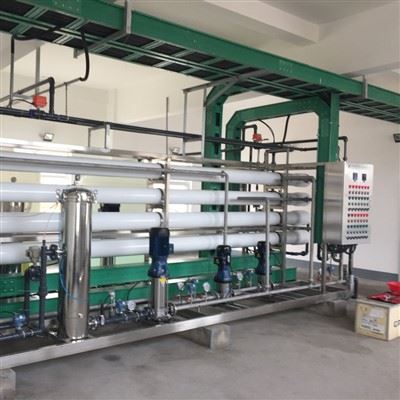
Taihe manufactures industrial reverse osmosis systems for manufacturing plants, EPC contractors, water treatment companies, system integrators and industrial water projects.
Established in 1998, Taihe combines water treatment engineering, equipment manufacturing, system assembly and technical support. Industrial RO systems are designed according to feed water conditions, required capacity, product water quality and site requirements.


Why Choose Taihe
Integrated In-House Capabilities: We combine water treatment process engineering with advanced equipment manufacturing and skid assembly under one roof.
Data-Driven Customization: System design is strictly based on feed water chemistry, required recovery rates, membrane loading, and precise operating pressures.
Complete System Supply: We deliver fully integrated units encompassing pretreatment, chemical dosing, instrumentation, PLC control, and CIP (Cleaning-in-Place) systems.
Rigorous Factory Testing: Every system is fully piped, wired, and hydraulically tested in-house before shipment to eliminate on-site installation risks.
Reliable International Support: We back all overseas projects with clear technical documentation, secure export packaging, and expert after-sales assistance.
Technical Specifications
|
Parameter |
Specification Range |
|
Permeate Flow Rate |
5 m³/hr to 100 m³/hr (scalable) |
|
Nominal Salt Rejection |
97.5% to 99.7% |
|
Operating Recovery Rate |
65% to 82% |
|
Operating Pressure |
1.2 MPa to 2.5 MPa |
|
Power Supply |
380V / 415V / 460V, 50/60Hz, 3-Phase |
Key Operational Benefits
High-Efficiency TDS Reduction
Eliminates minerals, silica, and ionic compounds from groundwater, surface water, or municipal supplies.
Scale and Corrosion Prevention
Protects high-pressure boilers, heat exchangers, and production machinery from mineral scaling and premature failure.
Consistent Output Purity
Delivers stable water quality parameters regardless of seasonal variations in source water mineral content.
Physical Filtration Barrier
Blocks bacteria, pyrogens, colloids, and high-molecular-weight organics without chemical residues.
System Process Flow
Pretreatment Stage: Raw water passes through multi-media filtration, activated carbon absorption, and micro-filtration to remove suspended solids and oxidants.
Chemical Dosing: Automated dosing injects specialized antiscalant inhibitors to prevent mineral precipitation on membrane surfaces.
High-Pressure Pumping: Vertical multi-stage centrifugal pumps pressurize pre-treated water to overcome osmotic resistance.
Membrane Separation: Pressurized water passes through spiral-wound elements housed in pressure vessels, splitting into permeate and concentrate streams.
Post-Treatment & CIP: Purified water flows to storage while concentrate is managed. An integrated clean-in-place skid handles periodic maintenance.

Core System Components
High-Pressure Pumps
Vertical centrifugal pumps selected for high hydraulic efficiency and low vibration under continuous load.
Membrane Assemblies
High-flux, fouling-resistant polyamide composite membranes housed in fiberglass-reinforced pressure vessels.
Control Architecture
Programmable logic controller paired with an industrial touch screen interface monitoring pressure, flow, conductivity, and pH.
Instrumentation Suite
Inline digital flow meters, pressure transmitters, temperature sensors, and conductivity monitors.
Valves & Piping
Schedule 80 UPVC or 304/316L stainless steel piping manifolds equipped with automated control valves.
Skid Framework
Heavy-gauge structural carbon steel framework finished with chemical-resistant industrial epoxy coating.
Typical Industrial Applications
Boiler Feed Water
Supplying makeup water to low and high-pressure steam boilers to eliminate scaling and blowdown heat loss.
01
Food & Beverage Production
Providing compliant water for product dilution, ingredient blending, and equipment washing.
02
Electronics Manufacturing
Delivering ultra-pure water loops for semiconductor washing and component rinsing.
03
Pharmaceutical Preparation
Producing purified water meeting pharmacopeia standards for general utility and equipment washing.
04
Power Generation
Supplying turbine cooling makeup water and scrubber replenishment.
05
System Selection Guide

Analyze Source Water Chemistry
Review complete laboratory water analysis reports focusing on total dissolved solids, hardness, silica, iron, and silt density index.

Define Purity Requirements
Determine maximum allowable conductivity, silica levels, and daily volume demands factoring in peak hours.

Evaluate Site Footprint & Utilities
Measure available floor space, ceiling height, drainage capacity, and electrical supply limits.

Assess Operational Constraints
Consider operator skill levels and local ambient temperatures when selecting automated flush cycles.
Customization & Engineering Options
Material Upgrades
Substitution of 316L stainless steel wetted parts or sanitary piping for corrosive environments.
Energy Recovery Integration
Addition of isobaric energy recovery devices or variable frequency drives to minimize electrical consumption.
Multi-Pass Configuration
Double-pass reverse osmosis integration for applications demanding ultra-low conductivity.
Containerized Skids
Weatherproof, pre-wired mobile container installations designed for rapid outdoor deployment.
Quality Control & Factory Testing Protocols
Material Traceability
Verification of material test certificates for pressure vessels, pumps, piping, and structural components.
Hydrostatic Pressure Testing
Pressure testing of all high and low-pressure piping manifolds at 1.5 times maximum operating pressure.
Electrical Safety Verification
Insulation resistance testing, ground continuity checks, and point validation on control panels.
Functional Dry Run
Simulation of automated valve sequencing, interlock triggers, and alarm points prior to crating.
Installation & Commissioning Guidelines
Modular Skid Delivery
Shipped as pre-assembled modules designed to minimize on-site rigging, welding, and alignment time.
Clear Interface Connections
Marked flanged inlet, outlet, concentrate, and drain connection points for straightforward tie-in.

Commissioning Support
Comprehensive installation manuals, piping schematics, electrical wiring diagrams, and startup assistance.
Operator Training
Technical briefings covering daily startup, routine monitoring, membrane cleaning, and alarm troubleshooting.
Spare Parts & After-Sales Support
Critical Component Stocking
Inventory of replacement membrane elements, O-rings, cartridge filters, and pressure switches.
Consumable Availability
Quick-ship replacement cartridges, antiscalant chemicals, and clean-in-place cleaning formulations.
Direct Technical Assistance
Troubleshooting support delivered directly by factory design engineers.
Maintenance Guidance
Scheduled maintenance protocols designed to extend membrane lifespan and prevent interruptions.
Frequently Asked Questions

Request an Industrial RO System Proposal
Ready to start your project? Send us your water analysis today.
For an accurate technical proposal and custom configuration, please provide:
Complete laboratory water analysis and feed source.
Required permeate capacity and operating schedule.
Target product water specifications and preferred configuration.
Site utility details and delivery timeline.
As one of the most professional industrial ro system manufacturers and suppliers in China, we're featured by quality products and good price. Please rest assured to buy customized industrial ro system from our factory.