

► When a Water Crisis Strikes, Time is of the Essence
Sudden natural disasters offer no time for preparation. In the wake of a hurricane, a sudden earthquake, or a prolonged drought, the municipal water supply system is often the first to fail. For governmental emergency management departments, rescue agencies, and coastal industrial enterprises, an interruption in the water source means that disaster relief efforts cannot be launched and production activities grind to a complete halt. At such a critical juncture where every second counts, the months or even years required for the construction cycle of traditional water conservancy projects are clearly inadequate to meet the immediate demand. The fundamental reason why containerized desalination plants have become the premier solution for emergency water supply is their ability to maximize the core element of speed.
► A Generational Leap in Deployment Speed
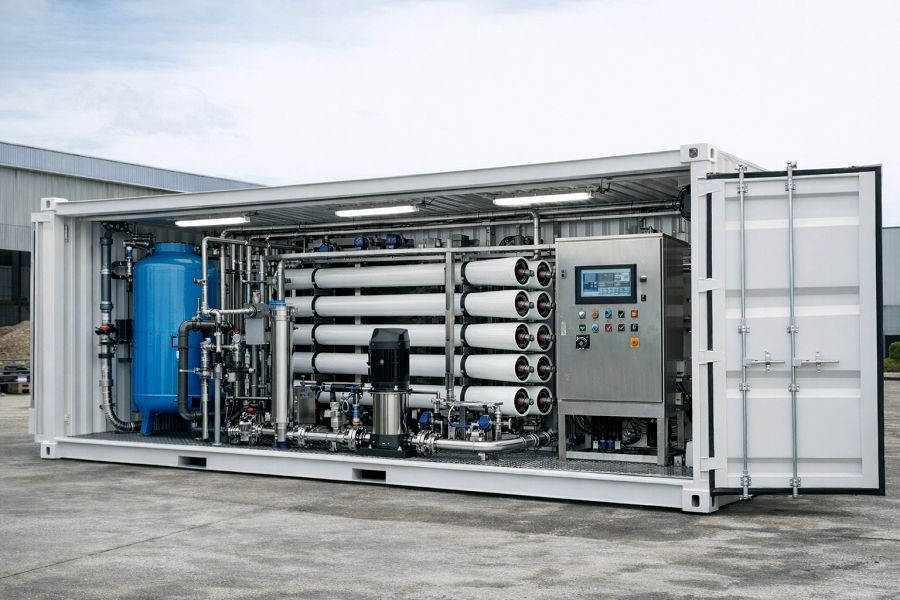
Compared to traditional, civil-engineered water plants, the advantages of containerized desalination solutions represent a paradigm shift. Traditional desalination projects involve land acquisition, concrete pouring, the hoisting of large-scale equipment, and complex pipeline installation. The entire process, from breaking ground to producing potable water, often spans more than a year. In contrast, a standard-specification containerized RO plant has all its core process units-including pretreatment, the seawater reverse osmosis membrane assembly, and post-treatment systems-highly integrated within a standard shipping container. Upon arrival at the site, the equipment only requires simple pipework and electrical connections to be commissioned and start operation. This "plug-and-play" characteristic compresses the response time for securing a water supply from a scale of "years" down to "weeks", buying invaluable time for post-disaster relief efforts.
► On-site Adaptability and Resource Utilization
Infrastructure in disaster-stricken areas is often severely damaged, and site conditions are complex. Whereas traditional projects require land leveling and building construction, the containerized solution has minimal site requirements. A patch of hardened ground, or even a reinforced beach area, can serve as a footprint for these modular units. For coastal regions facing freshwater crises due to tsunamis or storm surges, drawing water directly from the ocean is the most reliable solution. Containerized desalination plants can be positioned directly on the coastline, utilizing a reverse osmosis desalination system to convert the abundant seawater into valuable potable or industrial water. This effectively bypasses damaged inland freshwater networks, making them veritable "mobile water sources".
► Operational Flexibility and Strategic Reserve Value
Beyond their rapid emergency response capabilities, the flexibility of these units is also evident at the operational level. For rescue agencies, the disposal of fixed facilities after a crisis can be problematic. A containerized solution, however, can be lifted and relocated in its entirety, serving as a strategic reserve asset to be redeployed to the next area of need. For regions facing cyclical water shortages due to drought, leasing or stockpiling a number of containerized ro desalination plants is a far more pragmatic solution than waiting for long-term, uncertain cross-basin water transfer projects. It serves not only as a "lifeline" in disaster relief but also as a reliable dual-use buffer for both routine and emergency applications.