

1. The short answer: single-pass RO permeate is water a UPW train cannot tolerate
The first question most plants ask when starting an ultrapure water (UPW) project is the same one: our single-pass RO already delivers 10–20 µS/cm, so why invest in a second stage? The answer is simple - single-pass RO is built for "dirty" water, while the EDI and polishing mixed bed downstream of a UPW train cannot tolerate that water. The residual silica, boron, free carbon dioxide and trace ions in single-pass permeate force the polishing equipment into overload and shorten resin life dramatically. This is exactly why the double pass exists: it is not simply "one more filtration round," but a buffer wall built in front of the entire ultrapure water chain.
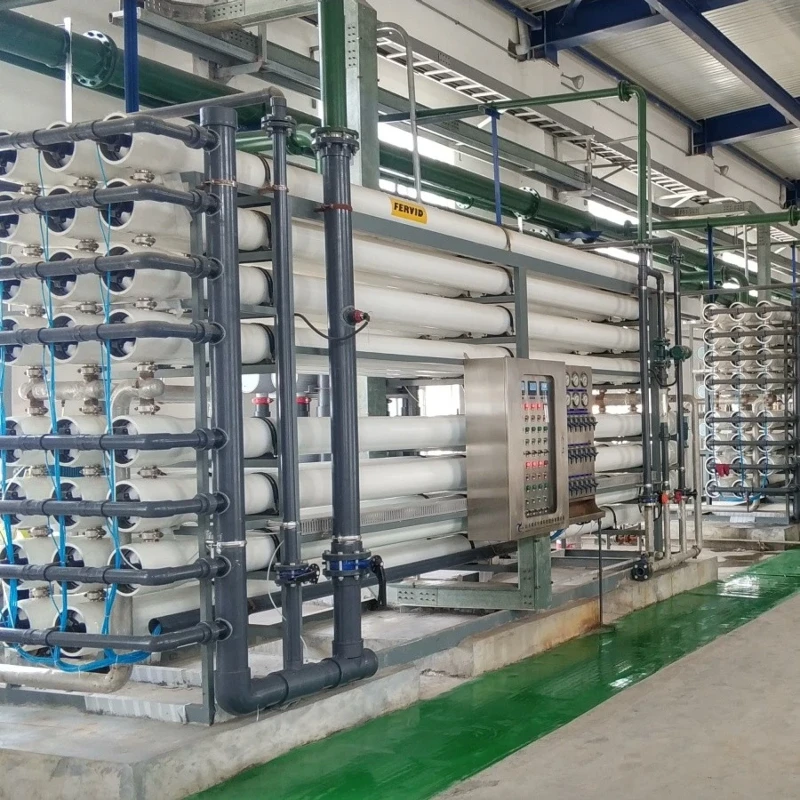
2. The complete workflow of a double pass RO system
A typical double pass RO system works in four steps:
Step one, first-pass desalination. Feed water that has gone through pretreatment (multimedia filtration, activated carbon, softening, 5 µm cartridge filtration) passes through the first-pass polyamide composite membranes at 1.2–2.5 MPa, removing about 98% of dissolved salts, most organics and particles, bringing permeate conductivity down to 10–20 µS/cm.
Step two, interstage conditioning - the most valuable step in the whole system. Before entering the second pass, first-pass permeate is dosed with caustic soda to raise pH to 8.5–9.0. The principle: the three hardest "escapers" in first-pass permeate - free CO₂, reactive silica and boron - are uncharged molecules under neutral or acidic conditions, which RO membranes can barely reject. Once caustic is added, they convert into charged bicarbonate, silicate and borate ions that the second-pass membranes can capture. Many buyers assume the performance gain of a double pass RO system for ultrapure water pretreatment comes simply from "one more membrane stage," but interstage caustic dosing actually contributes a large share of the improvement.
Step three, second-pass deep polishing. The conditioned permeate enters the second-pass high-pressure membrane array, where conductivity drops below 2 µS/cm, reactive silica is held under 10 ppb, and TOC is reduced by about 90%.
Step four, concentrate recycling and energy recovery. Second-pass concentrate is far cleaner than first-pass feed, so in practice it is often recycled to the first-pass inlet - pushing overall system recovery to 75–85% without wasting that "half-clean" water.
3. Double pass RO vs single pass RO: the numbers
● Salt rejection: about 96–98% for single pass, above 99.5% for double pass;
● Permeate conductivity: 10–20 µS/cm vs 1–2 µS/cm;
● Protection of downstream polishing (EDI, mixed bed): a double pass RO system for ultrapure water pretreatment lowers the ionic load entering the polishing loop by an order of magnitude, extending EDI module and mixed bed resin life by more than 3 times;
● The cost: roughly 40–60% higher capital investment, plus added energy consumption and footprint.
Quick sizing logic: if there is no EDI or mixed bed downstream, single-pass RO is enough; the moment a UPW train contains polishing equipment, the double pass is almost always the more economical choice for such projects - the resin replacement and acid/caustic regeneration costs it saves typically pay back the extra investment within 2–3 years.
4. Three frequently asked questions
Q: Is an interstage tank mandatory for a double pass RO system?
Recommended for large flows and fluctuating demand: the first pass "produces steadily" while the second pass "draws on demand," and each pass can start, stop and be cleaned independently. For small, stable flows a direct tank-less connection is possible, but it demands stronger engineering.
Q: Can we skip the caustic dosing?
Yes - the alternative is interstage membrane degassing (membrane contactor or vacuum degasifier), which strips CO₂ physically. Where feed silica and boron are low, degassing is sufficient; where they are high, caustic dosing is virtually the only effective method, because only the ionized form can be rejected by the membrane.
Q: Can double pass RO permeate be used as ultrapure water directly?
No. At around 2 µS/cm it is still three orders of magnitude away from the 18.2 MΩ·cm (25 °C) UPW standard; EDI, polishing mixed bed, UV and final filtration are required. The double pass is the "most reliable pretreatment," not the finish line.
Conclusion
The key to understanding the double pass RO is understanding its role in the UPW train: at moderate cost, it stabilizes the working environment of the expensive polishing equipment behind it. If your project is evaluating pretreatment options, send us your raw water analysis - Taihe Environmental will provide a double pass RO system for ultrapure water pretreatment proposal together with an EDI configuration and operating cost estimate based on your actual water quality data.