

What exactly is a brackish water treatment RO system, and how does it turn salty water into usable water? Let's start with a question one of our customers once asked: "We drilled a well at our factory. The water looks quite clear, but it tastes salty, and scale keeps building up on our equipment. Can this water actually be used?" The answer is yes, and in many cases, it is more cost-effective than you might expect. This type of water, which looks clear but tastes salty, is known in the industry as brackish water. The equipment used to turn it into a usable water resource is called a brackish water treatment RO system.
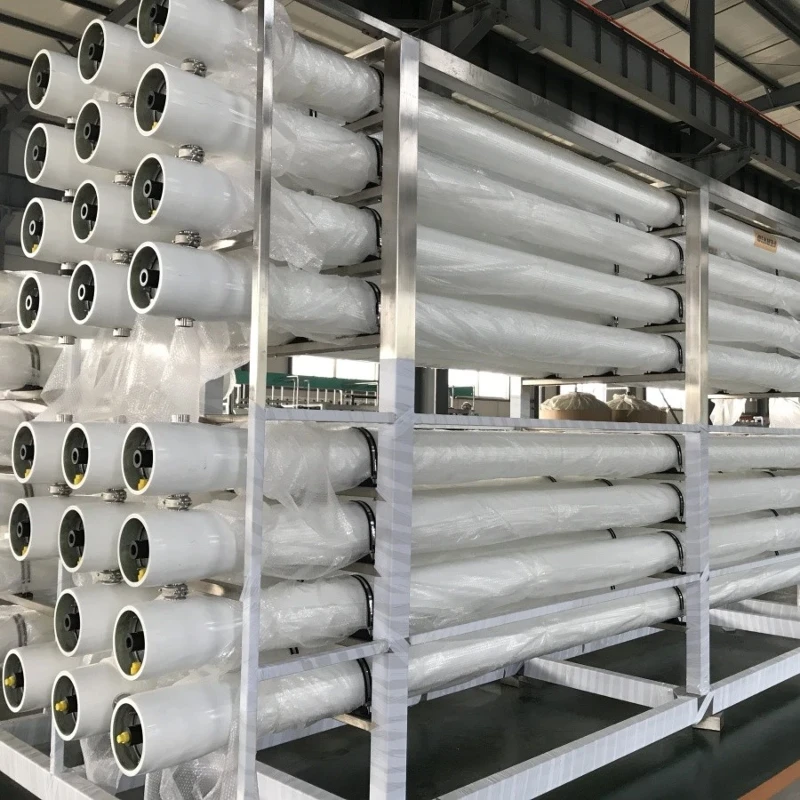
In this article, we'll explain three key questions: what is brackish water, how does a brackish water RO system work, and how is it different from seawater desalination? By the end, you'll be able to determine whether installing this type of equipment is worthwhile for your well water.
I. What Is Brackish Water, and How Salty Does Water Have to Be to Qualify?
First, let's clear up a common misconception: you cannot tell how salty water is just by looking at it. Water can look perfectly clear while containing considerable amounts of dissolved salts. The industry uses total dissolved solids (TDS) to measure this. TDS refers to the total amount of dissolved salts and minerals in one liter of water, measured in mg/L or ppm (the two units are numerically almost equivalent). Water can generally be classified as follows:
● Freshwater: TDS below 1,000 mg/L. Ordinary tap water and most surface water fall into this category;
● Brackish water: TDS approximately 1,000–10,000 mg/L. It is commonly found in groundwater from wells, coastal groundwater affected by seawater intrusion, and water from mining areas;
● Seawater: TDS approximately 35,000 mg/L, making it three to thirty-five times saltier than brackish water.
Brackish water therefore falls into an awkward middle ground: it is saltier than freshwater, so it cannot be used directly for drinking, fed into boilers, or used for irrigation without potentially harming crops. However, it is much less salty than seawater, making its treatment costs manageable. This is precisely the salinity range where reverse osmosis performs particularly well.
So, how can you determine the quality of your well water? Don't rely on taste. A water quality test that provides TDS, hardness, silica, iron, manganese, and other relevant data is far more reliable than any guesswork. Understanding brackish water vs seawater TDS is also an important starting point when selecting the right treatment process.
II. How Does Reverse Osmosis Remove Salt from Water?
The principle behind reverse osmosis can be explained in one sentence: pressure is applied to salty water to force it through an extremely fine membrane. Water molecules pass through, while dissolved salts are retained.
Let's first look at the concept of osmosis. If you soak a raisin in water, it absorbs water and swells because water naturally moves toward the side with a higher salt concentration. This is called natural osmosis. Reverse osmosis works in the opposite direction: sufficient pressure is applied to force water from the more concentrated side toward the less concentrated side. Reverse osmosis membranes have a dense selective layer that allows water molecules to pass through while rejecting most dissolved salts and ions, such as sodium, calcium, and chloride. Unlike conventional filtration membranes, RO membranes separate substances primarily through solution-diffusion rather than simple pore-size filtration.
The process produces two streams of water:
● One stream is the desalinated water, known in the industry as permeate, which can be used directly for suitable applications;
● The other is increasingly concentrated water, known as concentrate/brine, which carries away the rejected salts.
The core of this brackish water treatment RO system is the membrane combined with a high-pressure pump capable of raising the water pressure to 1.0–2.8 MPa (approximately 10–28 bar). The saltier the feed water, the higher the pressure required. Brackish water treatment requires only one-third to one-half of the pressure used in seawater desalination, which is one of the main reasons for its lower energy consumption.
III. A Complete System Involves More Than Just a Membrane
An RO system is not simply "a machine and a membrane." It is a complete treatment process in which each stage helps reduce the burden on the membrane.
Step 1: Water Intake. Well water is first pumped into a raw water tank. The tank stabilizes the water supply, buffers fluctuations in well water flow, and allows sediment to settle.
Step 2: Pretreatment. A multimedia filter containing different grades of sand and anthracite removes sediment, rust, and colloids. Water with high hardness requires antiscalant dosing (adding chemicals that inhibit scale formation and crystallization), or a water softener can be installed to remove calcium and magnesium. Water with excessive iron and manganese also requires oxidation and filtration beforehand. If pre-filtration and pretreatment are inadequate, suspended particles may damage the membrane surface, while scale formation can lead to membrane fouling and reduced performance. Even the best RO membrane cannot operate efficiently without proper pretreatment.
Step 3: Cartridge Filtration. Before entering the high-pressure pump, the water passes through another filtration stage equipped with a 5-micron cartridge filter. This removes any remaining fine particles that have passed through the previous filters, protecting both the high-pressure pump and the membrane elements.
Step 4: Reverse Osmosis Unit. After being pressurized by the high-pressure pump, the water enters the membrane elements. Under suitable feed water conditions and properly designed operating parameters, the RO system can typically achieve a salt rejection rate of 98.5%–99.5%, with permeate TDS potentially falling below 30 mg/L.
Step 5: Post-Treatment. RO permeate has a high degree of purity, but its taste may be relatively flat, and it may also be corrosive to pipelines. For drinking water applications, minerals need to be added back and disinfection is required. Boiler feed water may require pH adjustment. Whether this stage is necessary depends on the intended application; not every project requires it.
Step 6: Concentrate Management. Where do the rejected salts go? This is one of the most easily overlooked and potentially problematic aspects of a project. Inland projects do not have access to the sea for discharge, so the concentrate must either be sent to an evaporation pond, reused, or treated through a zero liquid discharge process. This must be determined during the design stage. Otherwise, even if the equipment has been installed, the project may still come to a standstill simply because there is nowhere to send the concentrate.
IV. Brackish Water RO vs Seawater RO: Why You Shouldn't Treat Them as the Same System
This is one of the most common misconceptions during equipment procurement. Although both systems use RO technology, brackish water RO and seawater RO systems differ significantly:
● Feed Water Salinity: Brackish water: 1,000–10,000 mg/L; seawater: 35,000 mg/L;
● Operating Pressure: Brackish water: 10–28 bar; seawater: typically 55–70 bar;
● Power Consumption: To produce the same 1,000 gallons of water, a brackish water RO system consumes approximately 0.4–0.6 kWh, while a seawater RO system consumes 4–6 kWh, a difference of nearly ten times;
● Membranes: Brackish water membranes (BW) and seawater membranes (SW) have different formulations. Using them interchangeably can compromise system efficiency and membrane service life;
● Recovery Rate: Brackish water RO systems generally achieve a recovery rate of 65%–85%, while seawater RO systems typically achieve 40%–50%.
Therefore, when requesting a quotation, don't simply say, "I need an RO system." Provide a water quality report so the supplier can configure the equipment according to the actual feed water quality. Even when two systems have the same capacity of 10 tons per hour, solutions designed for feed water with TDS levels of 2,000 mg/L and 8,000 mg/L may require completely different numbers of membrane elements, pump power ratings, and antiscalant dosages. Naturally, their quotations will also differ.
V. Where Can This Equipment Be Used?
Its range of applications is broader than most people think:
● Industrial Water Supply: Production water and equipment makeup water for food and beverage, textile, chemical, and electronics factories;
● Boiler Feed Water: Reduces salts and silica in the water to prevent boiler scaling and tube rupture;
● Cooling Tower Makeup Water: Reduces minerals in makeup water, helping minimize scaling and blowdown volume;
● Municipal Water Supply: Uses brackish water wells as a water source in towns and cities facing water shortages;
● Agricultural Irrigation: Reduces salinity to prevent damage to salt-sensitive crops;
● Remote Areas: Containerized equipment is easy to transport and install, making it suitable for mining areas and island projects.
Brackish groundwater treatment is particularly useful in areas where freshwater resources are limited but underground brackish water is readily available.
VI. Frequently Asked Questions
Q: Can water produced by a brackish water RO system be consumed directly?
The desalinated water itself is safe, but for drinking water applications, minerals generally need to be added back, disinfection is required, and the water must comply with local drinking water standards. For industrial applications, the required water quality depends on the specific process requirements.
Q: How often do RO membranes need to be replaced?
Typically, every 3–7 years, although the actual service life varies considerably. With clean feed water, proper pretreatment, and timely cleaning, membranes can last seven or eight years. However, if the feed water is dirty, no antiscalant is added, and increasing pressure differences are left unaddressed, the membranes may need to be replaced within just two or three years.
Q: Is a higher recovery rate always better?
No. Increasing the recovery rate from 70% to 85% can cause the salt concentration in the concentrate to rise significantly, sharply increasing the risk of scaling. In the industry, a recovery rate of around 75% is often considered the "sweet spot." Pushing it higher may require more expensive membranes and additional chemicals, while potentially shortening membrane service life.
Conclusion
Let's return to the well water we mentioned at the beginning. Water that looks clear but tastes salty doesn't mean it is unusable. Start with water quality testing, then determine the intended application, and only after that select the equipment model. When the process is approached in the right order, brackish water can actually be an underestimated water resource.
Taihe Environmental Protection has been engaged in industrial water treatment since 1998, and we have extensive experience with various well water and groundwater treatment projects. If you also have a water quality report and are unsure how to interpret it, feel free to send it to us. We can help you determine how to configure your brackish water treatment RO system, how to manage the concentrate, and approximately how much the project will cost. Let's discuss the details first before deciding whether to move forward.