

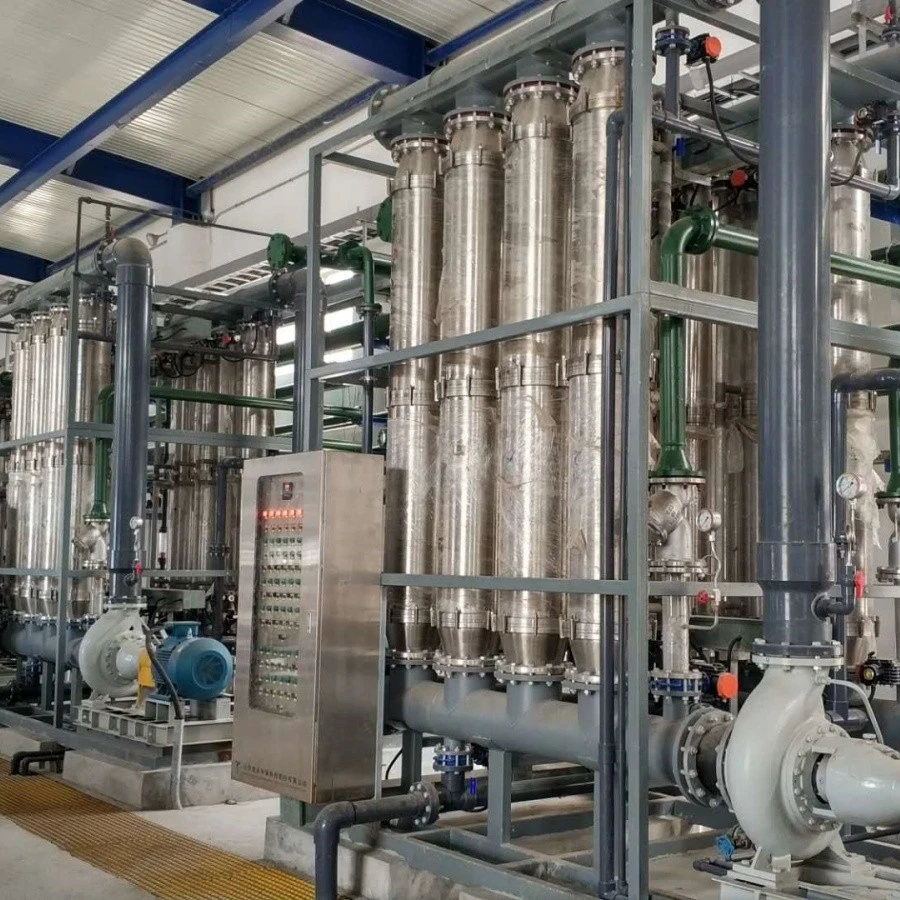
Product Overview
The High-Pressure Seawater RO System is a heavy-duty industrial desalination unit engineered to convert marine feed water with total dissolved solids up to 45,000 mg/L into high-purity permeate via multi-stage high-pressure membrane separation and integrated energy recovery.
Key Specifications
|
Parameter |
Technical Standard / Range |
|
Permeate Capacity |
50 m3/day to 2,000 m3/day per standard modular skid |
|
Design Feed TDS |
Up to 45,000 mg/L marine standard |
|
Operating Pressure |
5.5 MPa to 7.0 MPa |
|
Single-Stage Recovery |
35% to 45% (up to 85% with dual-pass configurations) |
|
Power Consumption |
3.0 kWh/m3 to 4.2 kWh/m3 |
Product-Specific Technical Focus
High-Pressure Energy Optimization: Integrates isobaric energy recovery devices to capture hydraulic energy from the high-pressure concentrate stream, reducing total plant power consumption by up to 40%.
Corrosion-Resistant Hydraulics: High-pressure manifolds, valve bodies, and pump wet ends utilize Super Duplex stainless steel (UNS S32750/S32760) and nickel-aluminum bronze to withstand aggressive chloride attack.
Precision Membrane Protection: Multi-stage cartridge filtration coupled with automated chemical dosing prevents particulate scaling and biological fouling across thin-film composite polyamide membranes.
Robust Structural Integrity: Skid frames are constructed from heavy-gauge structural carbon steel treated with marine-grade epoxy coating systems certified for offshore salt-fog resistance.
Typical Applications
Coastal Municipal Desalination: Primary freshwater supply plants for municipal networks in arid coastal zones.
Offshore & Marine Operations: Freshwater generation on floating production storage and offloading vessels, drillships, and commercial cargo fleets.
Remote Industrial Facilities: Continuous utility water provision for mining sites, remote coastal power stations, and island manufacturing hubs.
Commercial Resorts & Tourism: Standalone freshwater infrastructure for isolated island hospitality complexes.
Operating Principle & Process Flow
Feedwater Pretreatment: Raw seawater passes through multi-media filters and precision cartridge filters to remove suspended solids down to 5 microns, protecting downstream high-pressure components.
High-Pressure Pressurization: Plunger pumps elevate filtered feedwater to 6.8 MPa, creating the necessary thermodynamic driving pressure to overcome osmotic pressure.
Reverse Osmosis Separation: Pressurized water flows across spiral-wound polyamide membranes; water molecules pass through the molecular pore structure while dissolved ions, minerals, and organics are rejected into the concentrate stream.
Energy Recovery & Post-Treatment: High-pressure concentrate transfers energy via isobaric chambers to incoming feed water before discharge, while permeate undergoes pH adjustment and disinfection.
System Configuration
Pumping Subsystem: Multistage centrifugal feed booster pumps paired with high-efficiency positive displacement high-pressure pumps.
Membrane Assembly: FRP pressure vessels housing high-rejection seawater RO elements arranged in optimized array configurations.
Control Architecture: Programmable Logic Controller integrated with color touchscreen interface, automated valve actuation, and real-time instrumentation telemetry.
Chemical Cleaning Skid: Built-in Clean-In-Place tank, chemical mixing pump, and electric immersion heater for routine membrane maintenance.
Seawater Feed Water Requirements
|
Turbidity |
< 1.0 NTU. |
|
Silt Density Index |
SDI 15 < 3.0. |
|
Free Chlorine |
0 mg/L (strict requirement to prevent polyamide membrane oxidation). |
|
Feed Temperature Range |
5°C to 35°C. |
|
Oil and Grease |
Undetectable (< 0.1 mg/L). |
Product Water Quality
|
Total Dissolved Solids |
< 300 mg/L (exceeds World Health Organization drinking water guidelines). |
|
Boron Concentration |
< 0.5 mg/L (via dual-pass configuration for agricultural or industrial semiconductor use). |
|
Chloride Ion Concentration |
< 50 mg/L. |
|
Silt Density Index |
SDI < 2.0 in permeate output. |
Selection & System Design Guide
Feed Salinity Mapping: Select operating pressure brackets based on local seasonal seawater temperature and maximum salinity profiles.
Capacity Sizing: Calculate daily volumetric demand incorporating a 15% operational contingency margin and scheduled maintenance downtime.
Footprint Assessment: Evaluate available installation area and vertical clearance for skid placement and membrane element extraction paths.
Power Supply Matching: Verify local electrical grid voltage, frequency compatibility, and transformer capacity for high-power motor loads.
Customization Options
Dual-Pass Configuration: Secondary RO pass integration for ultra-low boron and total dissolved solids reduction targeting industrial boiler feed requirements.
Material Upgrades: Full titanium high-pressure piping manifolds and pump wet ends for extreme hypersaline environments exceeding 60,000 mg/L TDS.
Containerized Enclosures: Systems pre-installed inside ISO 20-foot or 40-foot high-cube shipping containers complete with HVAC, lighting, and internal piping insulation.
Explosion-Proof Electrical: ATEX/IECEx certified motors, instrumentation, and control panels for hazardous offshore oil and gas platform installations.
Quality Control Standards
Material Traceability: Mill test certificates verified for all pressure-containing metallic components and piping assemblies.
Hydrostatic Pressure Testing: Skid piping assemblies pressure-tested to 1.5 times maximum design working pressure prior to electrical integration.
Factory Acceptance Testing: Full wet-run testing conducted on completed skids to record flow rates, rejection percentages, and pump vibration signatures.
Welding Inspection: All pressure vessel and piping welds undergo non-destructive examination including radiographic and dye penetrant testing.
Frequently Asked Questions
Hot Tags: high-pressure seawater ro system, China high-pressure seawater ro system manufacturers, suppliers, best reverse osmosis system for hard water, osmosis water filtration, portable reverse osmosis system, ro pure, ro water filter machine, small ro filter