

As a ceramic membrane supplier, I've witnessed firsthand the remarkable growth and innovation in the field of membrane technology. Ceramic membranes have emerged as a crucial component in various industries, offering exceptional performance, durability, and versatility. In this blog post, I'll delve into the quality standards for ceramic membranes, providing insights into what makes a high - quality ceramic membrane and why it matters.
1. Material Quality
The foundation of a high - quality ceramic membrane lies in the raw materials used. The most common materials for ceramic membranes are alumina (Al₂O₃), zirconia (ZrO₂), and titania (TiO₂). Each material has its own unique properties that influence the membrane's performance.
Alumina is widely used due to its high mechanical strength, chemical stability, and relatively low cost. High - purity alumina powders are essential for producing membranes with uniform pore structures. For example, 99% pure alumina can ensure better resistance to chemical corrosion and higher mechanical integrity. Zirconia, on the other hand, offers superior thermal stability and fracture toughness. It is often used in applications where high - temperature resistance is required. Titania is known for its photocatalytic properties, which can be beneficial in water treatment applications for the degradation of organic pollutants.
The particle size and distribution of the raw materials also play a crucial role. Uniform particle size helps in achieving a consistent pore size distribution in the final membrane. Manufacturers should carefully select and control the raw materials to meet the desired quality standards. For instance, using a narrow particle size distribution of alumina powder can result in a membrane with a more precise pore size, which is essential for applications such as microfiltration and ultrafiltration.
2. Pore Structure
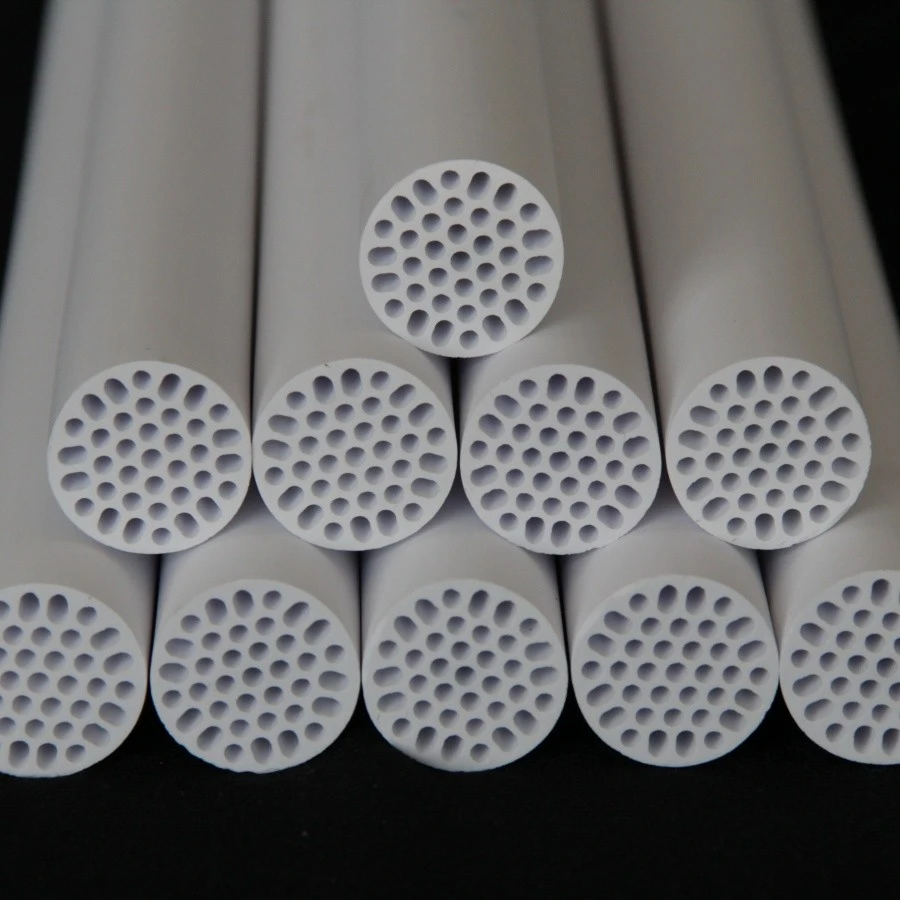
The pore structure of a ceramic membrane is one of the most critical quality indicators. It includes parameters such as pore size, pore size distribution, and porosity.
Pore Size
The pore size determines the membrane's separation capabilities. Different applications require different pore sizes. For example, in drinking water treatment, microfiltration membranes with pore sizes in the range of 0.1 - 10 micrometers are commonly used to remove suspended solids, bacteria, and some large viruses. Ultrafiltration membranes, with pore sizes between 0.001 - 0.1 micrometers, can remove smaller particles, including macromolecules and some viruses. Nanofiltration and reverse osmosis membranes have even smaller pore sizes for more advanced separation tasks, such as desalination.
The accuracy of the pore size is crucial. A membrane with a well - defined pore size can provide more reliable and consistent separation performance. For example, a ceramic membrane for oil - water separation needs to have a pore size that allows water to pass through while retaining oil droplets. If the pore size is too large, oil will pass through the membrane, reducing the separation efficiency.
Pore Size Distribution
A narrow pore size distribution is desirable for high - quality ceramic membranes. It ensures that the membrane has a more uniform separation performance. A wide pore size distribution can lead to inconsistent separation results, as larger pores may allow unwanted particles to pass through while smaller pores may cause excessive resistance to the flow of the filtrate.
Porosity
Porosity refers to the volume fraction of pores in the membrane. Higher porosity generally means higher permeability, which is beneficial for achieving high flux rates. However, too high porosity can compromise the mechanical strength of the membrane. Therefore, a balance needs to be struck between porosity and mechanical strength. For example, in applications where high flux is required, such as large - scale water treatment plants, a membrane with relatively high porosity can be used, but it should still maintain sufficient mechanical integrity to withstand the operating pressures.
3. Mechanical Properties
Ceramic membranes need to have adequate mechanical properties to withstand the operating conditions. This includes properties such as strength, hardness, and fracture toughness.
Strength
The membrane should be able to withstand the pressure applied during the filtration process without breaking or cracking. Compressive strength is particularly important, as membranes are often subjected to high pressures in applications such as reverse osmosis and some forms of ultrafiltration. For example, in a desalination plant, the ceramic desalination membrane needs to withstand the high osmotic pressure during the reverse osmosis process. Tensile strength is also relevant in some cases, especially when the membrane is subjected to stretching or bending forces.
Hardness
Hardness is related to the membrane's resistance to abrasion. In applications where the feed solution contains abrasive particles, a hard ceramic membrane can resist wear and maintain its performance over a longer period. For example, in mining wastewater treatment, where the water may contain sand and other abrasive materials, a hard ceramic membrane can prevent premature damage.
Fracture Toughness
Fracture toughness measures the membrane's ability to resist crack propagation. A membrane with high fracture toughness is less likely to break under stress, which is crucial for ensuring the long - term reliability of the membrane. This property is especially important in applications where the membrane may be exposed to sudden changes in pressure or temperature.

4. Chemical Resistance
Ceramic membranes are often used in harsh chemical environments, so they need to have excellent chemical resistance. They should be resistant to acids, bases, and organic solvents.
In water treatment applications, the membrane may come into contact with various chemicals used for disinfection, pH adjustment, and scale prevention. For example, in a drinking water treatment plant, the ceramic membrane for drinking water treatment may be exposed to chlorine, which is a common disinfectant. A high - quality ceramic membrane should be able to resist the corrosive effects of chlorine and other chemicals without significant degradation of its performance.
In industrial processes, such as chemical manufacturing and oil refining, the membrane may be exposed to more aggressive chemicals. For instance, in an oil - water separation process, the Ceramic Membrane for Oil Water Separation may come into contact with hydrocarbons, acids, and bases. The membrane should be able to maintain its integrity and separation performance in such environments.
5. Surface Properties
The surface properties of the ceramic membrane can also affect its performance. A smooth surface can reduce fouling, which is the accumulation of unwanted substances on the membrane surface. Fouling can lead to a decrease in flux and an increase in operating pressure, ultimately reducing the efficiency of the membrane system.
Surface charge is another important property. A charged surface can interact with charged particles in the feed solution, either attracting or repelling them. This can be used to enhance separation performance. For example, in the treatment of wastewater containing charged colloids, a membrane with a surface charge opposite to that of the colloids can help in their removal.
6. Manufacturing Process
The manufacturing process has a significant impact on the quality of ceramic membranes. A well - controlled manufacturing process can ensure that the membrane meets all the quality standards.
The process typically includes steps such as powder preparation, forming, sintering, and post - treatment. Each step needs to be carefully optimized. For example, during the sintering process, the temperature, heating rate, and holding time need to be precisely controlled to achieve the desired pore structure and mechanical properties. A too - high sintering temperature can lead to excessive densification and a decrease in porosity, while a too - low temperature may result in insufficient bonding between the particles and a weak membrane.
Quality control measures should be implemented throughout the manufacturing process. This includes in - process inspections and final product testing. Non - destructive testing methods, such as ultrasonic testing and X - ray diffraction, can be used to detect internal defects in the membrane. Final product testing should include performance tests, such as flux measurement, rejection rate measurement, and chemical resistance tests.
Why Quality Standards Matter
High - quality ceramic membranes offer several advantages. They provide more reliable and consistent separation performance, which is crucial for ensuring the quality of the treated product. For example, in drinking water treatment, a high - quality Ceramic Membrane for Drinking Water Treatment can effectively remove contaminants and ensure the safety of the drinking water.
They also have a longer service life, which reduces the need for frequent membrane replacement. This can result in significant cost savings for the end - users. In addition, high - quality membranes are more resistant to fouling and chemical degradation, which means less maintenance and lower operating costs.
Contact for Procurement
If you are in the market for high - quality ceramic membranes that meet the strictest quality standards, we are here to assist you. Our company offers a wide range of ceramic membranes for various applications, including drinking water treatment, oil - water separation, and desalination. We are committed to providing our customers with the best products and services. Whether you have a small - scale project or a large - scale industrial application, we can work with you to find the most suitable ceramic membrane solution. Please contact us to start a procurement discussion and take advantage of our expertise in ceramic membrane technology.
References
- Cheryan, M. (1998). Ultrafiltration and Microfiltration Handbook. Technomic Publishing Company, Inc.
- Mulder, M. (1996). Basic Principles of Membrane Technology. Kluwer Academic Publishers.
- Baker, R. W. (2004). Membrane Technology and Applications. John Wiley & Sons.