


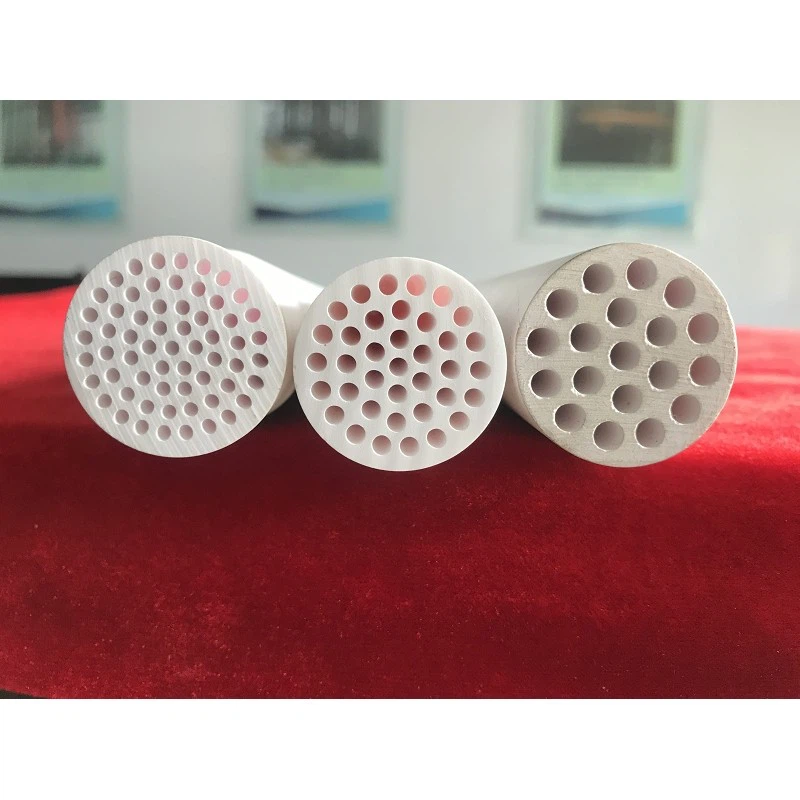


Advantages of ceramic membranes for oil water separation / produced water treatment
Ceramic membranes are particularly suitable for oilfield produced water, refinery wastewater and other high-fouling oily streams. Our CERAMEMBR® technology can handle fluctuating oil content and high TSS without flux collapse, achieve stable permeate quality (<5 mg/L oil, in our project cases, no oil detected after treatment), and tolerate aggressive CIP up to NaOCl 2000 ppm or hot caustic, high flux (typically 150–500 L/m²·h for ultrafiltration of oily water) and long service life over 20 years make them an enabling core technology before downstream polishing such as RO, ion exchange or biological steps.
What is a ceramic membrane?
A ceramic membrane is an inorganic porous filtration medium made of alumina, zirconia or titanium oxide. Unlike polymeric membranes, ceramic elements are produced by sintering at high temperature, giving them a rigid structure with precisely controlled pore sizes from microfiltration to ultrafiltration range. They are widely used in harsh industrial environments where organic membranes cannot survive. Our CERAMEMBR® ceramic membranes have pores size only 0.03 um, can remove almost all impurities, microorganisms and harmful bacteria in the water.
How do ceramic membranes for oil water separation work?
Ceramic membranes for oil water separation operate via cross-flow filtration: the oily water flows tangentially along the membrane surface, while clean permeate passes through the porous layer driven by pressure. Oil droplets, suspended solids and colloids are retained on the membrane surface. The high shear cross-flow and smooth ceramic surface significantly reduce fouling and make chemical back-wash and high-pressure hot cleaning feasible.
Ceramic membranes vs polymeric membranes for oil water separation
Compared with polymeric membranes, ceramic membranes have superior mechanical strength, thermal resistance up to 300 °C, and excellent chemical tolerance to strong acids, alkalis, oxidants and solvents. They are hydrophilic and more resistant to irreversible fouling by oil. Although the initial CAPEX of ceramics is higher, the total cost of ownership is often lower due to longer lifetime, higher flux stability, and lower cleaning frequency.


Q&A of ceramic membranes for oil water separation
Q: Where are ceramic membranes typically used?
A: They are widely applied in water treatment, oil & gas, chemical processing, food & beverage, and pharmaceutical industries.
Q: Where are ceramic membranes typically used?
A: They are widely applied in water treatment, oil & gas, chemical processing, food & beverage, and pharmaceutical industries.
Q: How do ceramic membranes compare with DAF (dissolved air flotation)?
A: Ceramic membranes achieve consistent particle removal without chemical dosing, whereas DAF performance varies with oil/fat concentration and requires flocculants.
Q: How is ceramic membrane cleaned?
A: Using backwash, chemical cleaning, or CIP (clean-in-place) methods depending on fouling type, e.g., acid for scaling, alkaline for organic fouling.
Hot Tags: ceramic membranes for oil water separation, China ceramic membranes for oil water separation manufacturers, suppliers, ceramic ultrafiltration membrane, alumina membranes, ceramic membrane microfiltration, Ceramic Membranes Used For Water Treatment, ceramic reverse osmosis membrane, porous ceramic membrane